Your guitar has more rights than you think, and fewer than you’d hope.
Since 2015, a federal rule (14 CFR Part 251, from Section 403 of the FAA Modernization and Reform Act of 2012) has required US airlines to let you carry a guitar-sized instrument into the cabin. Here is what it actually says.
What the rule gives you
A guitar-sized instrument can come on board as your carry-on, as long as it fits safely in an overhead bin or under a seat.
No instrument fee. The airline can charge its normal carry-on or bag fees, but nothing extra because it’s an instrument.
Size limits bend for instruments. An instrument larger than the airline’s usual carry-on size must still be accepted if it fits the bin.
Airlines can’t ban instrument types or refuse them with a blanket “fragile items” policy.
Checked instruments up to 165 pounds and 150 total linear inches must travel as checked baggage, not cargo.
The catch
It applies only if there is space when you board. Bin space is first come, first served, and the airline doesn’t have to move other passengers’ bags for you. Once your guitar is stowed, though, nobody can remove it to make room for theirs. That’s why boarding early matters more than quoting the rule.
What the rule doesn’t do
It doesn’t guarantee space, and the instrument still counts toward your carry-on limit.
It doesn’t require airlines to sell a seat for a larger instrument (most US airlines do anyway).
It doesn’t cover foreign airlines, even on a trip that starts in the US. On a codeshare, the airline actually flying each leg sets the rule.
Whether a guitar fits depends on the aircraft. Small regional jets often have bins too small for a guitar case.
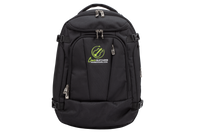
The Ascender answer: folded, an Ascender is about 18½ × 12½ inches, so it travels in a backpack within a standard carry-on size. You don’t need the rule’s special treatment.
Section 02
The US airlines at a glance
Every US airline follows the federal rule. The differences are in bag sizes, fares and extra seats.
Airline
Standard carry-on
Guitar on board
Worth knowing
Delta
22 × 14 × 9 in
Accepted as your free carry-on item if there’s space
Gate-check is the fallback. Partner airlines on codeshares may have different rules.
American
22 × 14 × 9 in
Small instruments as carry-on, first come, first served
Larger instruments can ride in a purchased seat. Damage claims need a hard case.
United
22 × 14 × 9 in
Small instruments in the bin or under the seat
Basic Economy includes only a personal item, so a guitar costs a carry-on fee. Seat purchase available.
Southwest
24 × 16 × 10 in
Instruments over carry-on size can board if they fit the bin
Southwest now charges for checked bags and has moved to assigned seating, so bins fill faster. Boarding position matters.
JetBlue
22 × 14 × 9 in
An instrument can replace one carry-on item
Blue Basic fares don’t include a carry-on; choose a Blue fare or higher. Seat purchase available.
Before you book
Read the fare rules. Basic economy fares on several airlines include only a personal item. A guitar then costs you a carry-on fee, or doesn’t fit at all.
Look at the aircraft. Mainline jets (737, A320 family and larger) have bins that fit most gig bags. Regional jets often don’t, and carry-ons get checked at the plane door.
Print the rule and your airline’s policy. A printed copy settles most gate conversations. The American Federation of Musicians (afm.org) links to both.
Save your record locator and flight numbers in case you need to file a complaint.
The Ascender answer: a folded Ascender fits a standard carry-on size on every airline in this table, so fare rules matter more than the instrument rule.
Carry-on sizes and policies change. Confirm with your airline before every trip.
Section 03
Winning the overhead bin
Strategy beats arguing. These are the habits that get guitars on planes.
Board early
Buy early or priority boarding if your fare doesn’t include it. It’s the cheapest insurance your guitar will ever have.
Use status and card perks. Airline credit cards and elite status often include priority boarding.
Be at the gate before boarding starts, ready to go when your group is called.
Stow it smart
Put the guitar in the bin lengthwise first, then let other bags go around it.
If the bin above your row is full, ask a flight attendant about space farther back or a closet up front.
Use a padded gig bag that fits the bin. A big hard case protects better when checked, but is harder to get on board.
What to say at the gate
“Hi, this is a musical instrument. Under the DOT rule I can bring it on board if there’s room in a bin. I’m happy to put it toward the back or wait for space. What works best for you?”
Mention the rule once, politely, then focus on solutions.
If the answer is still no, calmly ask for a supervisor and show your printed copies.
If you’re asked to gate-check, ask for a planeside (valet) tag so the guitar is handed back at the aircraft door.
If you have to check it
Loosen the strings slightly to ease neck tension. Use a hard case if you can.
Put a luggage tag with your name, phone and email on the case, and a note with your contact details inside.
Photograph the guitar and its serial number before you hand it over.
The Ascender answer: the bin battle mostly disappears when your guitar is in a backpack. If space runs out, a folded Ascender can often go under the seat in front of you.
Section 04
Through security
TSA screening is simple once you know what to expect.
Every instrument is screened, carried on or checked. Carry-on instruments get a hands-on inspection at the checkpoint.
Tell the officer if your guitar needs special handling, and ask to watch it being inspected.
TSA Cares can help plan screening for a valuable instrument. Contact them at least 72 hours before your flight at tsa.gov or (855) 787-2227.
Tools: TSA allows small tools under 7 inches, such as Allen keys, in carry-on bags. Final say rests with the officer at the checkpoint.
Checked cases: use TSA-recognized locks so officers can open the case without breaking it, and leave handling instructions inside.
If something goes wrong
Stay calm and keep records.
Show the printed federal rule and your airline’s instrument policy.
Offer options: stow it at the back of the plane, in a closet, or under the seat.
Ask for a supervisor before you board if you can’t agree.
If your guitar is damaged, report it to the airline before you leave the airport and photograph everything.
File a complaint with the airline, and with the US Department of Transportation at transportation.gov/airconsumer.
The Ascender answer: a folded Ascender goes through the X-ray in its bag like any backpack. Leave a little time in case the officer wants a closer look.
Section 05
Flying internationally
The US rule stops at US airlines. Abroad, most carriers treat a guitar as ordinary cabin baggage.
Foreign airlines aren’t covered by the US rule, even on flights to or from the US.
Most apply normal cabin-bag sizes. A full-size guitar case is usually over the limit, so expect to check it or buy a seat.
Ryanair requires a guitar larger than your cabin-bag allowance to travel in a purchased extra seat or be checked for a fee.
Lufthansa and Swiss loosened their rules in March 2026: an instrument can come on board if its height, width and depth add up to no more than 125 cm (about 49 inches). A full-size guitar case still doesn’t fit.
Europe has no US-style rule yet, though musicians’ groups are pushing for one.
Tips for international trips
Check each airline on your itinerary; on a codeshare, the airline flying that leg decides.
Weigh your bags. Cabin-bag weight limits abroad can be as low as 7 to 10 kg.
Carry your guitar’s purchase receipt so customs doesn’t mistake it for an import.
If you must check a full-size guitar, a flight case and travel insurance are worth the cost.
The Ascender answer: folded, an Ascender measures about 47 × 32 cm, well inside Lufthansa’s 125 cm combined limit and typical cabin-bag sizes abroad. This is where a folding guitar saves the most money and worry.
Section 06
Protecting the guitar itself
Travel is hard on wood, finishes and setups. A few habits prevent most damage.
Temperature
Never leave a guitar in a hot or freezing car. After a cold trip, let the case sit closed for an hour before opening. Sudden warming can crack lacquer finishes.
Setup on the road
Climate changes can shift neck relief. Carry the right Allen keys for small adjustments. Pack spare strings and a string winder; fresh strings hold tune better after a flight.
Humidity
Dry hotel rooms and planes can shrink wood and leave sharp fret ends. Acoustic guitars benefit most from a humidity pack in the case.
Paperwork
Photograph the guitar and serial number. Check whether your home or renters insurance covers instruments away from home, or for professional use. If not, consider instrument insurance.
Checked guitar? Loosen strings slightly, fill empty space in the case so nothing moves, and mark the case “Fragile, musical instrument.”
The Ascender answer: every Ascender ships with the Allen keys it needs for truss rod and strike plate adjustments, and the Ciari Travel Pack adds a spare set for your gig bag.
Bonus
The 48-hour gig trip checklist
Print it, tape it inside your bag, and tick it off before every fly-in gig.
The guitar
The rig
The paperwork
Travel day
Or skip most of this list. The Ciari Ascender is a full-scale electric guitar that folds in half and travels in a backpack. Nashville-crafted, with a 30-day return policy. See all models at ciariguitars.com.
Travel lighter. Play anywhere.
Your guitar should travel as easily as you do.
Discover the full-scale electric guitar that folds in half and travels in a backpack.
This guide is general information, not legal advice. Airline policies change often. Confirm with your airline before every trip. Sources listed in the supplied guide: US DOT musical instrument rule and FAQs; TSA; American Federation of Musicians; airline websites. Checked November 2026.